Have you ever wondered why one person leaves a job after six months while another stays for twenty years?
Why one person walks away from a relationship after the first signs of disrespect, while another keeps hoping things will change?
If you’ve ever wondered why leaving can feel so difficult even when you know you’ve outgrown something, I explore that in more depth in Why It’s So Hard to Leave What You’ve Already Outgrown.
Why some people completely reinvent their lives several times, while others remain in the same place for decades?
I’ve asked myself these questions many times.
And the more I thought about it, the more I realized there probably isn’t one answer.
It’s usually a combination of many things. Let’s explore them…

Safety: What Does Your Nervous System Protect?
What Does Our Nervous System Call “Safe”?
Our nervous system doesn’t ask: What’s best?
It asks: What feels safest?
Safe doesn’t necessarily mean pleasant. It often means familiar.
Sometimes we stay because everything looks fine on the outside, even when something inside knows we’ve already changed. I wrote more about this in When Your Life Still Looks Good But Doesn’t Feel Right.
For example;
Our nervous system prioritizes survival over happiness. When we stay in a toxic job, unfulfilling relationship, or stagnant routine, our nervous system often prefers predictable discomfort over unpredictable uncertainty.. And that’s the – familiarity trap: To our primitive brain, “safe” does not mean healthy; it means known. And stepping into “prediction deficit,” our brain registers as a literal physical threat.
So, bad conditions we understand feel safer than great conditions we cannot predict. And this is how our survival system “delays” us from change.
And safety is different for everyone.
For one person:
Leaving a toxic relationship = Freedom.
For another:
Leaving the same relationship = Abandonment. Loneliness. Identity collapse.
Same action, but different nervous system.
Another example:
For one person leaving a job may feel uncertain, but for another staying in an environment where they’re shrinking feels even more dangerous.
Question:
What feels safer to you right now: staying where you are, or stepping into uncertainty?
But safety isn’t fixed. One of the biggest factors that changes our perception of risk is self-trust.
Self-Trust Changes the Equation
This one is huge. People often think courage comes first. I think self-trust comes first.
When you trust yourself, uncertainty becomes less frightening.
Because you stop believing:
I need to know exactly what will happen.
And start believing:
Whatever happens, I’ll figure it out.
That’s a completely different operating system. Without self-trust unknown is perceived as danger, while with self-trust it becomes adaptability.
Self-trust isn’t built through positive thinking; it is built through evidence. Every difficult situation you’ve survived quietly teaches your brain: “I’ve handled uncertainty before, I can handle it again.”
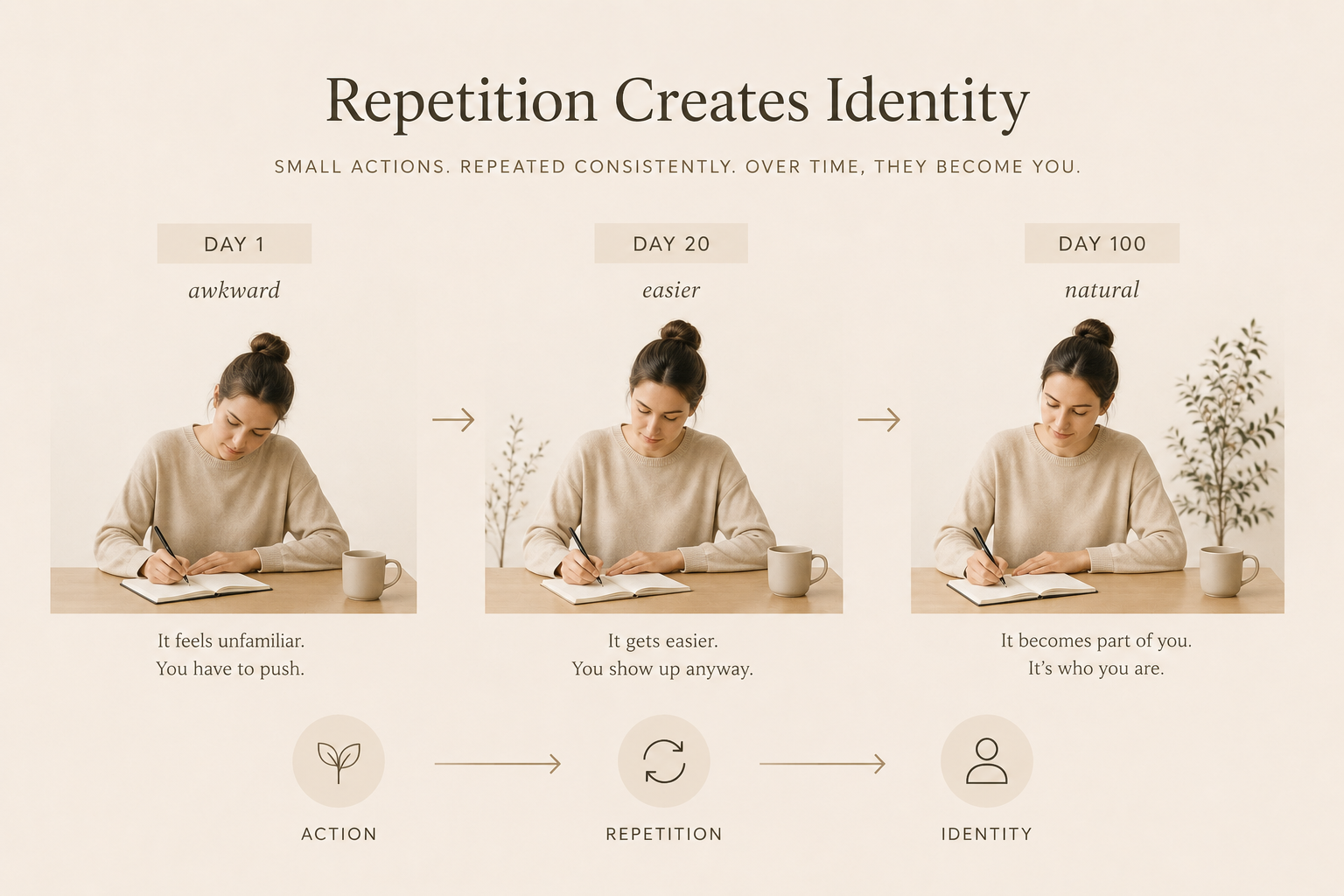
Building self-trust often requires becoming someone who behaves differently before it feels natural – a process I explored in How to Change Your Identity.
Question:
Do you trust that you’ll be okay if life doesn’t go according to plan?
Temperament: Why We Don’t All Respond to Change the Same Way
Our Temperament Shapes Our Relationship with Change
Some people genuinely enjoy: novelty, exploration, change, uncertainty.
While others naturally prefer: stability, predictability, consistency.
Neither of them is better. They simply create different relationships with change.
If someone would tell you how your life is going to look like in the next 10 years; where you are going to live and how… One person may got excited by that idea, but another one, with a different personality, may deeply dislike that idea. Just like I would dislike it. 🙂
Question:
When you look back at your life, have you generally been someone who seeks new experiences, or someone who enjoys building depth in familiar environments?
Values: What Are You Unwilling to Sacrifice?
We stay because we’re protecting certain values. We leave because we’re protecting others.
The Cost of Staying vs The Cost of Leaving
This one also plays a big role in change. And everyone calculates this differently.
Sometimes I am looking at some of my friends, their situation with the work or relationship. I can see how much they struggle and how unhappy they are, but somehow they still decide to stay in those unhappy situations. And it made me really think – why? I think deep inside myself I would have already left that job, relationship…
So, what are the costs of staying vs. leaving?
Costs of leaving, whether a relationship, a job or something else: money, identity, relationships, certainty, routine/predictability.
Costs of staying: energy, curiosity, joy, authenticity, growth, self-respect.
And maybe change happens when one internal equation flips.
Instead of: Leaving feels more dangerous than staying, it becomes: Staying feels more dangerous than leaving.
But dangerous how? Sometimes it’s…
“I’ll waste my life.”
“I’m betraying myself.”
“I’m becoming someone I don’t recognize.”
“I’m shrinking.”
“I’m slowly dying inside.”
They’re signals that one of your important values is no longer being honored.
Sometimes the greatest cost of staying isn’t external, it’s the small ways we gradually abandon ourselves. If that resonates, you may enjoy How to Stop Abandoning Yourself in Small Everyday Moments.
Question:
Which price feels heavier to you today?
Growth: What Makes You Feel Most Alive?
This one is very important in a different way to each one of us.
What kind of growth makes you feel alive?
For example; I love change, I love new beginnings, I love challenge, I love exploring and I love growing but not that much in a linear way. When I look back at my life, it was everything but not linear growth. From studying biology to working in marketing, then becoming a flight attendant, being in love with yoga practice but then suddenly being consistent with the gym… Living in five different countries over the last thirteen years…
But then there are some people who choose to work in the same company for over 10, 15 years. They change positions, departments, responsibilities, still growing, but just differently. They prefer mastery, depth in one area, expertise, long-term building, stability, known…
And for me, thinking about that idea is – I can’t imagine staying for ten years...
Maybe growth isn’t universal. Maybe everyone has their own version of growth.
Sometimes what we’re calling boredom is actually growth asking for a new direction. I explored this from another perspective in When Your Life Still Looks Good But Doesn’t Feel Right.
Question:
What kind of growth makes you feel most alive?

When Change Finally Happens
Perhaps change happens when all of these pieces begin to shift at the same time.
Your nervous system starts feeling less safe staying than leaving.
Your values evolve.
Your self-trust grows.
The cost of betraying yourself becomes greater than the cost of uncertainty.
Your curiosity becomes stronger than your fear.
Eventually, something inside quietly says:
“I can’t stay here anymore.” Not because you’re running away.
Because you’ve grown beyond where you are.
“Growth rarely announces itself with certainty. More often, it begins as the quiet feeling that the life you’ve built no longer reflects the person you’ve become.”
Maybe the question isn’t why some people change and others don’t.
Maybe the better question is:
What inside of me still believes that staying is safer than becoming?
Love&Light,
Romy